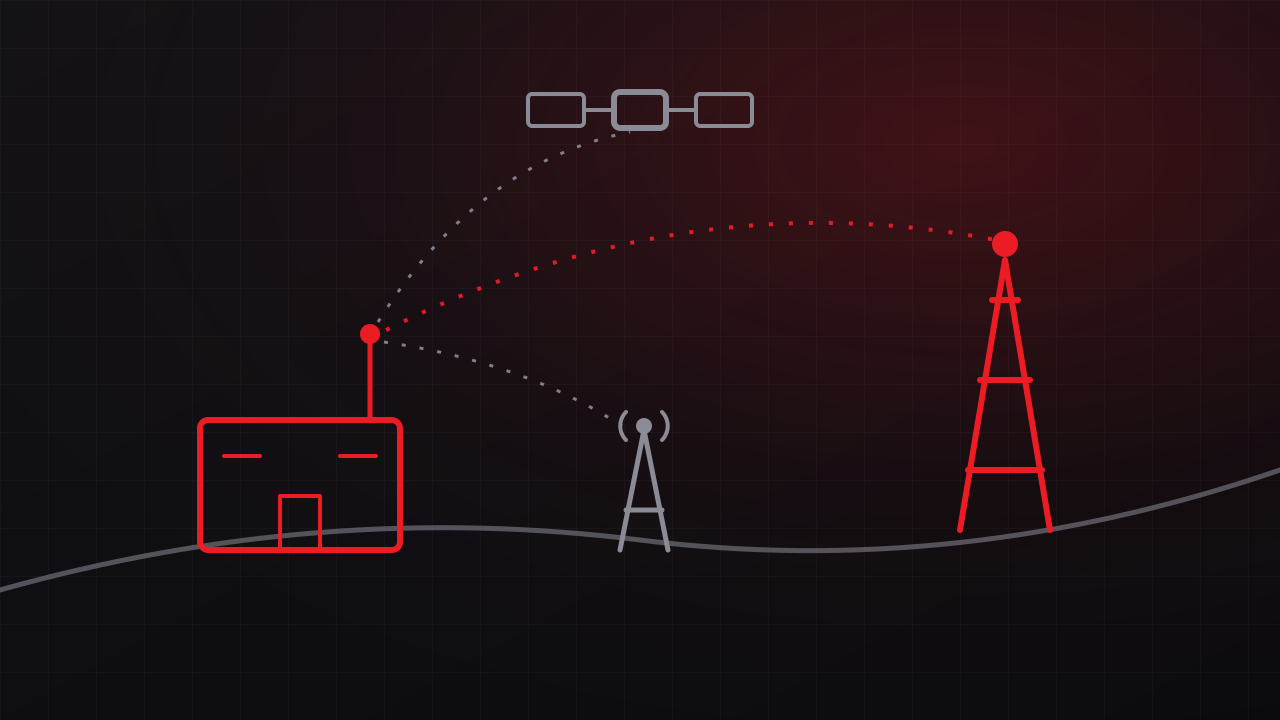
Point-to-Point Wireless vs. Cellular, Satellite, or Fiber
Comparing point-to-point wireless, cellular, satellite, and fiber for business and remote sites: capacity, latency, reliability, cost structure, and when each fits.
When a site needs a connection, the choice usually comes down to four technologies: fiber, point-to-point fixed wireless, cellular, and satellite. The short answer: use fiber where it is available at a reasonable cost, consider point-to-point wireless where fiber is out of reach and a line-of-sight path exists, and use cellular and satellite for backup or for sites nothing else can reach. The details of your site decide which one fits.
What they have in common
All four can deliver business-grade connectivity when engineered properly, and all four fail sometimes. Each needs a correctly configured router or firewall at the site, power protection, and monitoring. For anything important, plan a primary and a backup path built on two different technologies.
Fiber
Strengths: the highest capacity, low and stable latency, and little sensitivity to weather.
Watch for: availability. Extending fiber to a site that does not have it can involve construction, permits, and lead times that stretch over months, with costs driven by distance and terrain. A single fiber route is also exposed to construction dig-ins and pole damage.
Best fit: sites where fiber is already nearby, and facilities whose bandwidth needs justify the construction.
Point-to-point wireless
Strengths: high capacity over distances of several miles with a clear path, latency comparable to wired service, and fast deployment once the path is confirmed. A privately owned link carries no monthly circuit fee, and a link from a fixed wireless provider brings service to places wired carriers have not built.
Watch for: line of sight. The path needs clearance through the Fresnel zone around the direct line, and terrain, trees, and new construction can block it. Higher-frequency, higher-capacity links are more affected by heavy rain. Licensed microwave bands require FCC frequency coordination and licensing, and in exchange they offer protection from interference.
Best fit: sites with a clear view of a tower, a hilltop, or another connected building, including many agricultural and industrial sites around the Santa Maria Valley.
Cellular
Strengths: fast deployment, no construction, and wide availability. Current 4G LTE and 5G service can deliver solid throughput where the signal is strong.
Watch for: variable performance. Throughput and latency change with signal strength, tower load, and time of day. Business plans may carry data limits or lower priority during congestion. An external antenna mounted high on the building often improves signal quality substantially, and a router with two SIMs on different carriers adds diversity.
Best fit: backup links, temporary sites, and primary service where coverage is strong and bandwidth needs are modest.
Satellite
Strengths: coverage almost anywhere with a clear view of the sky. Low-earth-orbit (LEO) services such as Starlink have changed this category: latency is typically in the tens of milliseconds, compared with roughly 600 milliseconds or more round trip for traditional geostationary satellite service.
Watch for: the terminal needs an unobstructed view of the sky, and trees or structures in part of that view cause interruptions. Service terms, capacity during busy hours, and support vary by plan. At off-grid sites, the terminal’s power draw is a significant load for a solar system to carry.
Best fit: sites with no terrestrial options, rapid deployments, and backup paths that share nothing with local terrestrial infrastructure.
Side by side
| Option | Main risks | Best use |
|---|---|---|
| Fiber | Availability, construction, dig-ins | Primary wherever it is available |
| Point-to-point wireless | Line of sight, heavy rain on high bands | Primary where fiber is out of reach |
| Cellular | Coverage and congestion | Backup, temporary sites, light loads |
| LEO satellite | Sky obstructions, plan terms | Remote primary, independent backup |
Recommendation and trade-offs
For most business and industrial sites, the strongest designs pair two technologies with different failure modes:
- Fiber primary with cellular or LEO backup for sites with fiber service
- Point-to-point wireless primary with cellular or LEO backup for sites beyond fiber with a clear path
- LEO primary with cellular backup for remote sites without line of sight to a tower
Check that the two paths do not share a weak point, such as the same tower, the same power source, or the same pole line. Our guide to designing connectivity for a remote facility covers failover, power, and monitoring in more detail, and our article on fixed wireless for rural business sites explains how an engineered wireless link is planned.
Find out what your site can reach
GTech builds and operates fixed wireless service across the Santa Maria Valley and designs connectivity for remote and industrial sites through our networking and telecommunications practice. We start with a free desktop feasibility study that shows which options your site can actually reach. Free consultation: 805-979-9897.